Dataset Design
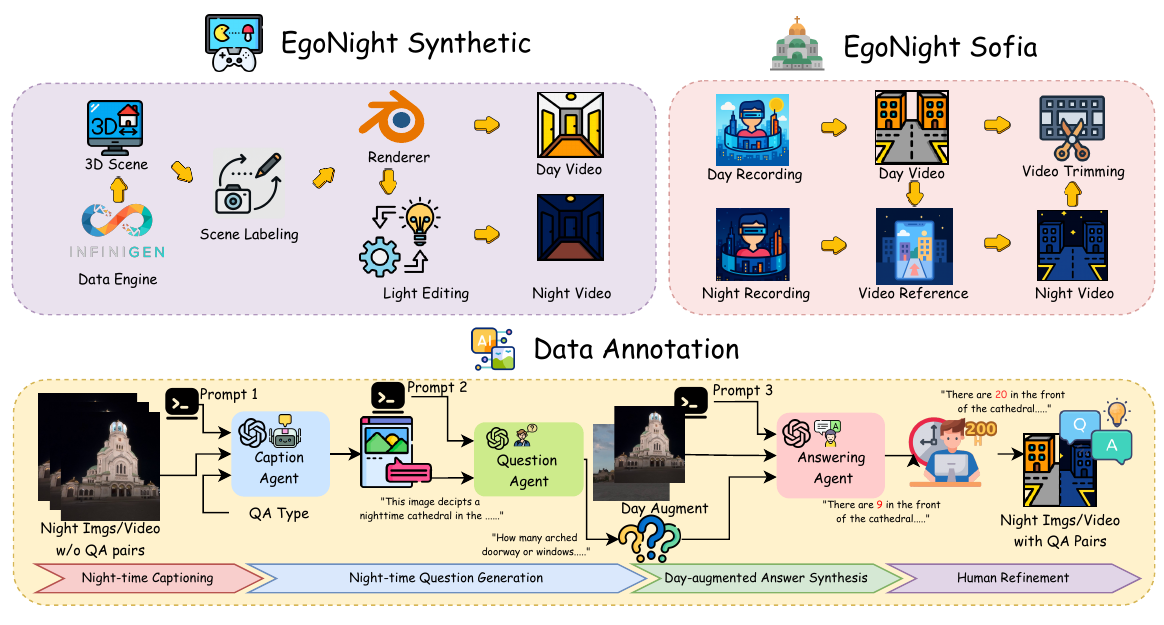
EgoNight combines aligned synthetic and real-world sources with diverse scenes, illumination types, and easy/medium/hard difficulty levels.
 Synthetic: 50 aligned pairs
 Sofia: 20 aligned pairs
 Oxford: 20 night videos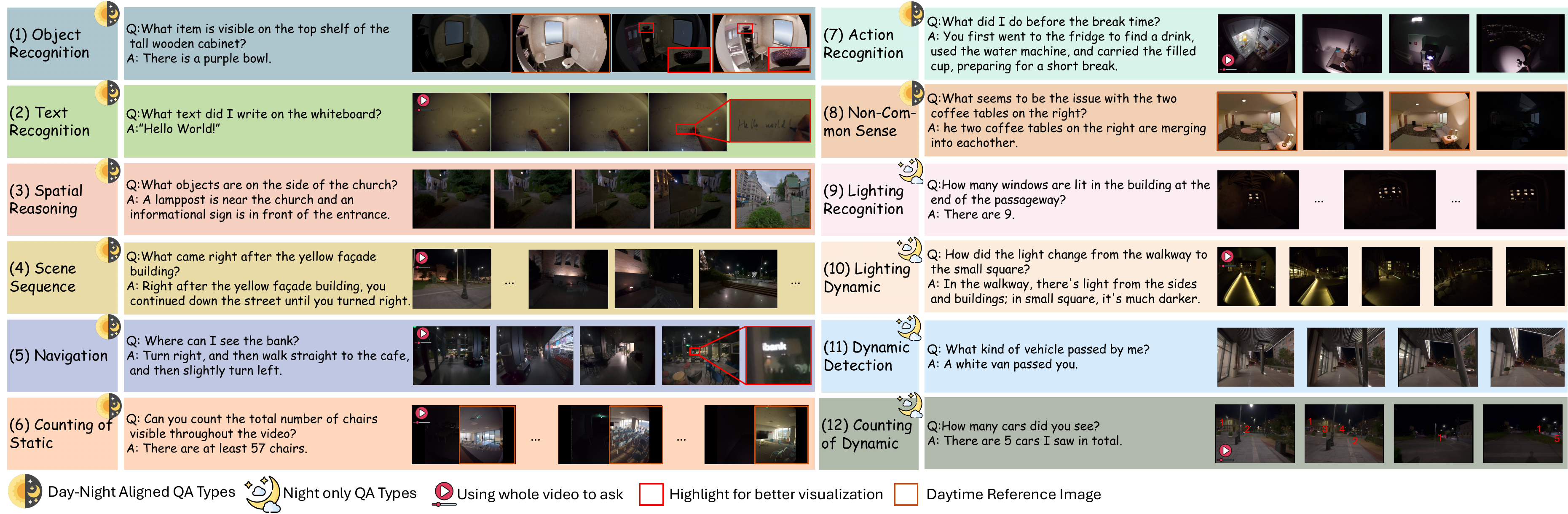
1 INSAIT, Sofia University 2 East China Normal University 3 HKUST(GZ) 4 Nankai University 5 Fudan University
 ICLR 2026
EgoNight is the first benchmark suite for nighttime egocentric vision, centered on VQA and extended with retrieval and depth estimation.
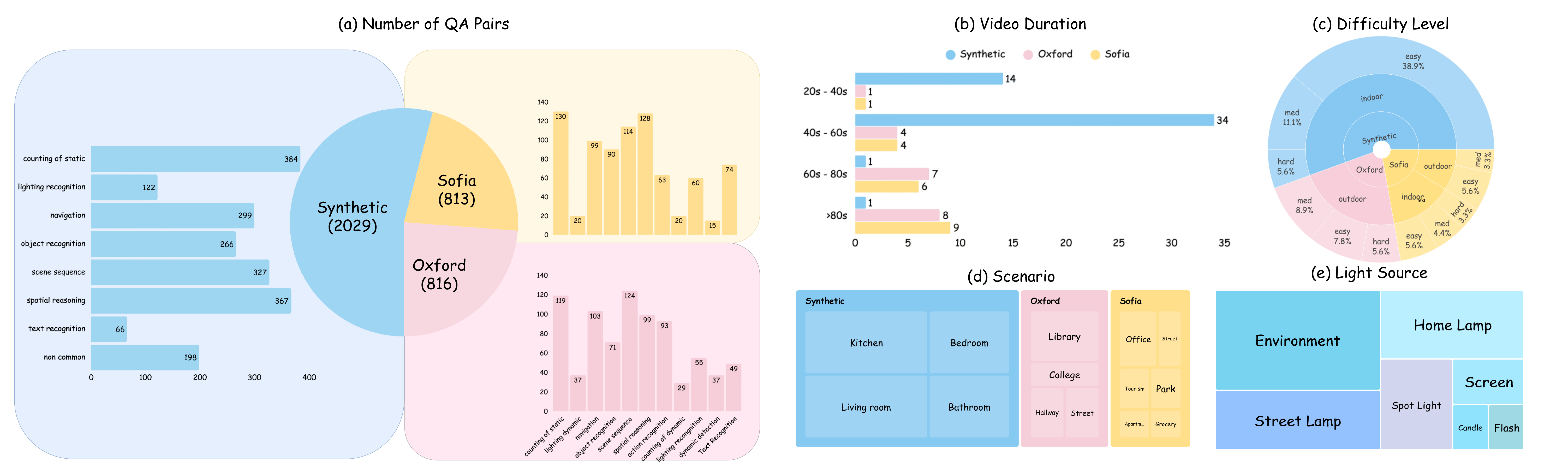
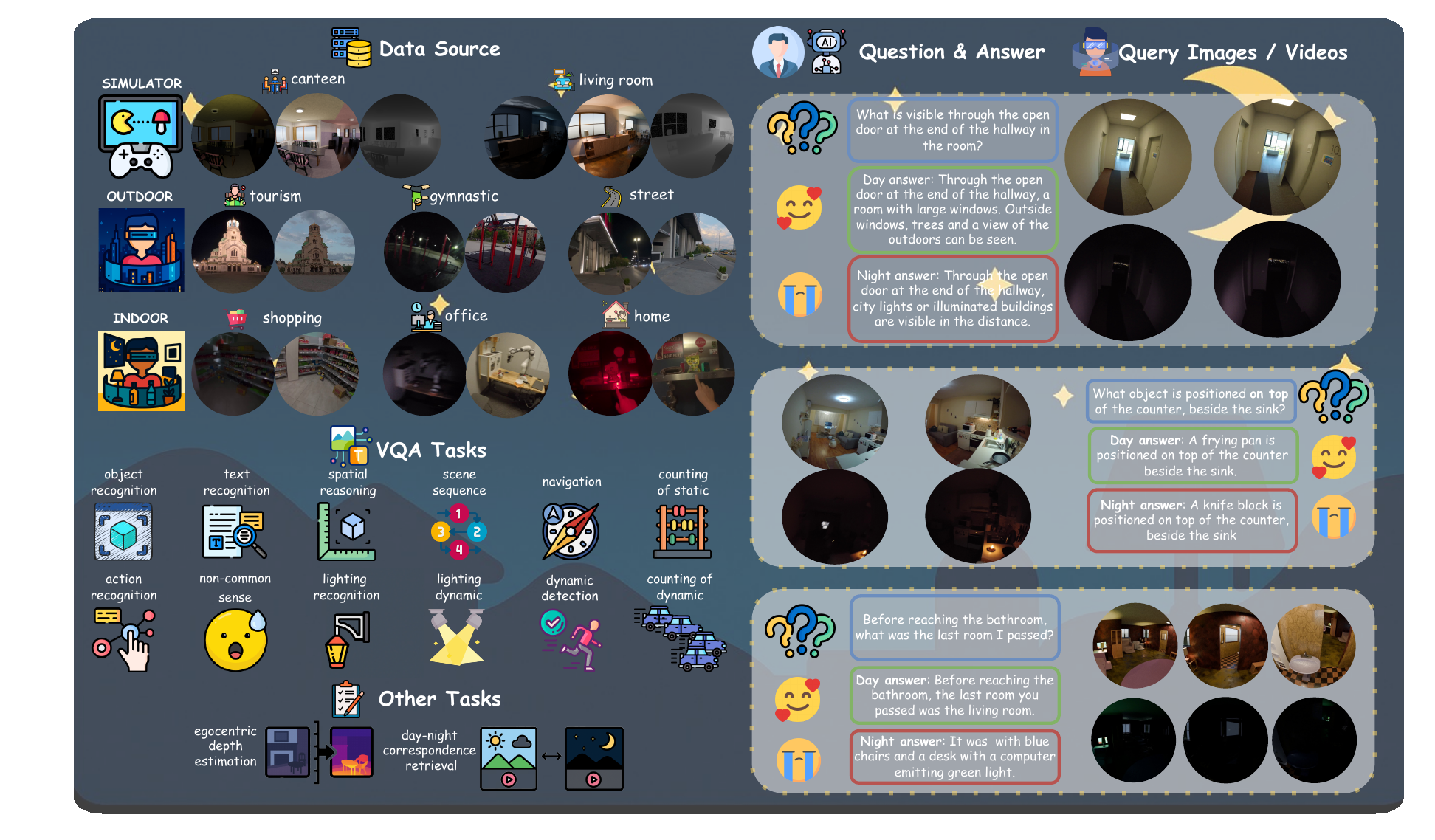
EgoNight combines aligned synthetic and real-world sources with diverse scenes, illumination types, and easy/medium/hard difficulty levels.
Synthetic: 50 aligned pairsSofia: 20 aligned pairsOxford: 20 night videos
All 3,658 QA pairs are manually verified. Total annotation effort: 300+ hours.
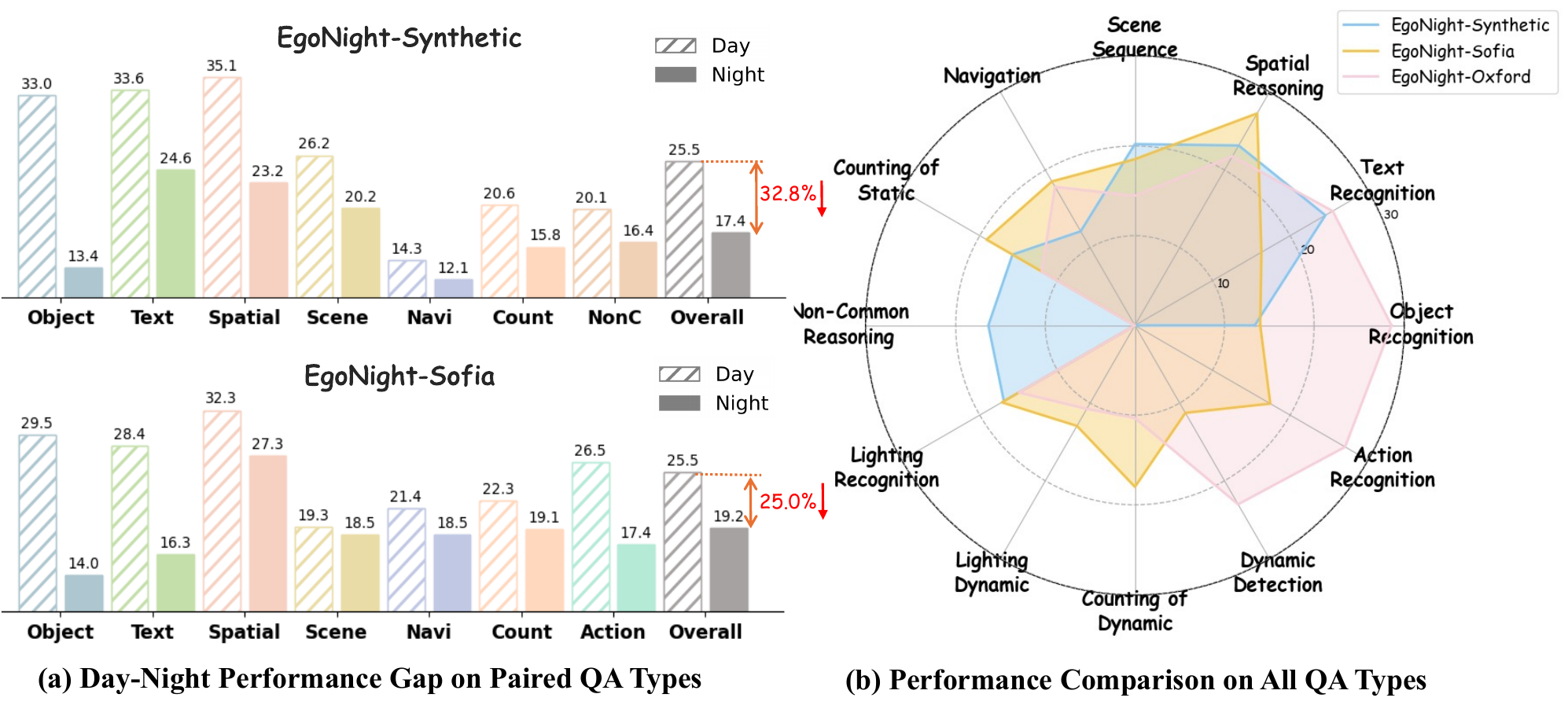
Even top MLLMs struggle under nighttime egocentric settings.
| Category | Best model | Avg. Acc (%) |
|---|---|---|
| Closed-source |  GPT-4.1 GPT-4.1 |
30.93 |
| Open-source |  InternVL3-8B InternVL3-8B |
20.06 |
| Egocentric |  EgoGPT EgoGPT |
14.29 |
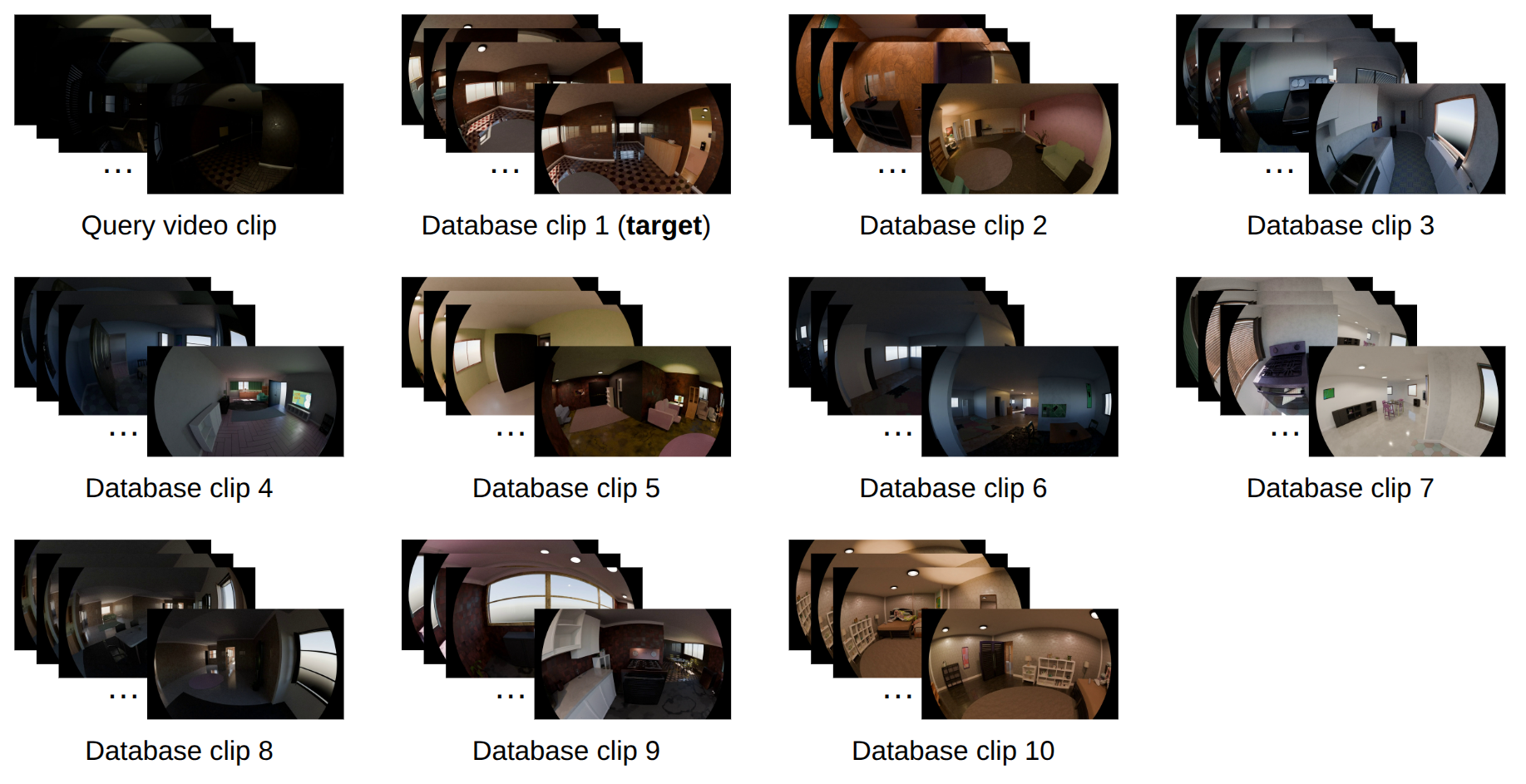
| Model | Spatial N->D (Syn/Sofia) | Temporal N->D (Syn/Sofia) |
|---|---|---|
| GPT-4.1 | 54.1 / 84.5 | 10.0 / 15.5 |
| Percep. Enc. | 41.6 / 80.9 | 32.9 / 33.4 |
| DINOv2 | 28.7 / 74.5 | 33.7 / 33.1 |
| InternVL3-8B | 27.7 / 56.3 | 9.9 / 13.3 |
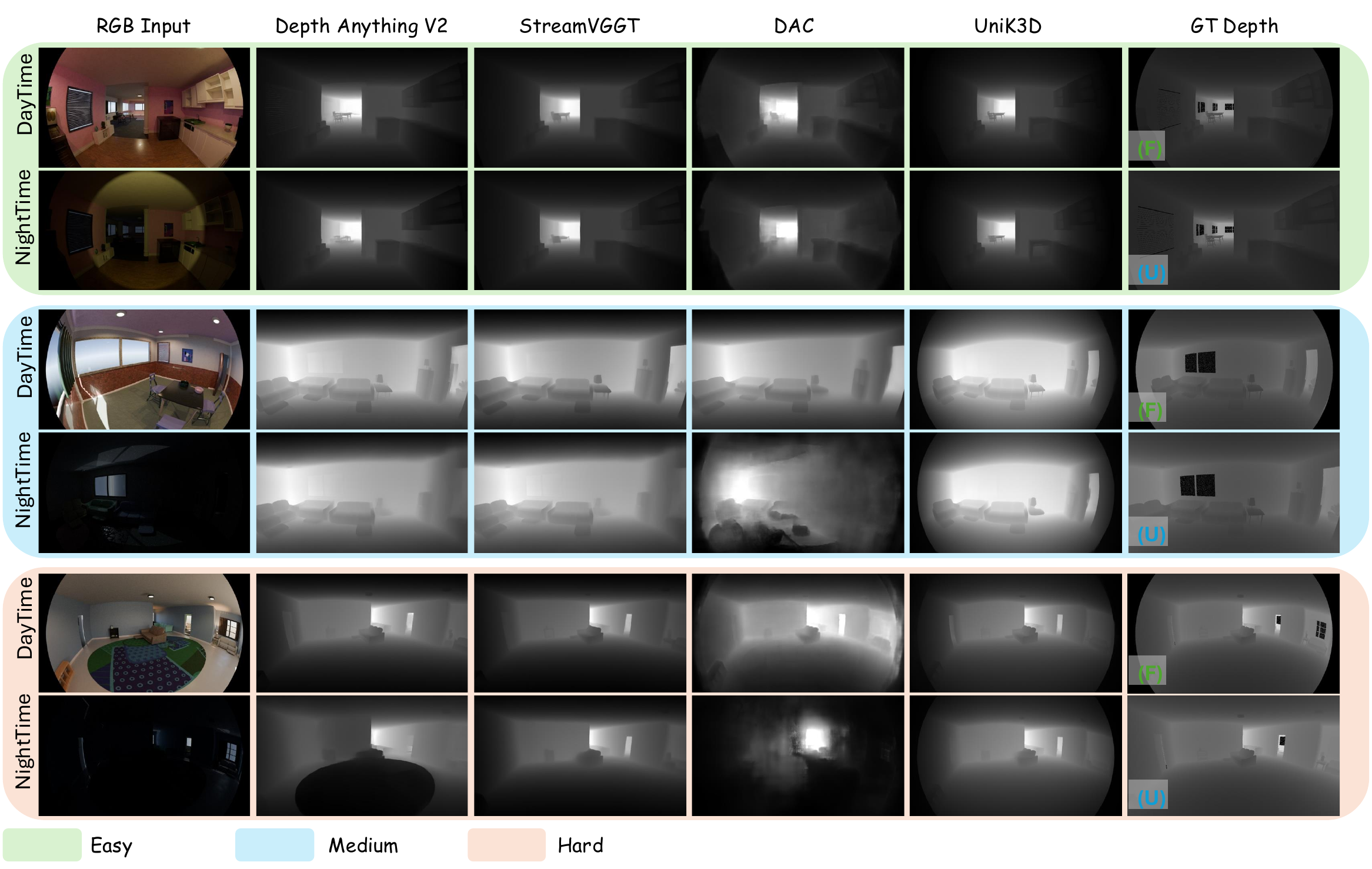
| Method | AbsRel D/N | delta1 D/N |
|---|---|---|
| Depth Anything | 0.297 / 0.302 | 0.249 / 0.237 |
| VGGTStream | 0.293 / 0.298 | 0.234 / 0.232 |
| DAC | 0.245 / 0.292 | 0.255 / 0.216 |
| UniK3D | 0.224 / 0.253 | 0.280 / 0.254 |
Copyright (c) 2026 EgoNight authors. All rights reserved.